


Are Farmers Skeptical About Carbon Programs?
The topic of carbon farming has been gaining popularity in recent years; however, relatively few farmers and industry professionals can clearly define what the entire process actually involves. The emerging voluntary carbon programs and the assumptions of the EU Common Agricultural Policy (CAP) are often confused. To better understand farmers’ perspectives, I conducted a small survey among two Polish farmers involved in the industry to find out what aspects of carbon farming they find difficult to understand and what their opinions on the topic are.
Small survey study:
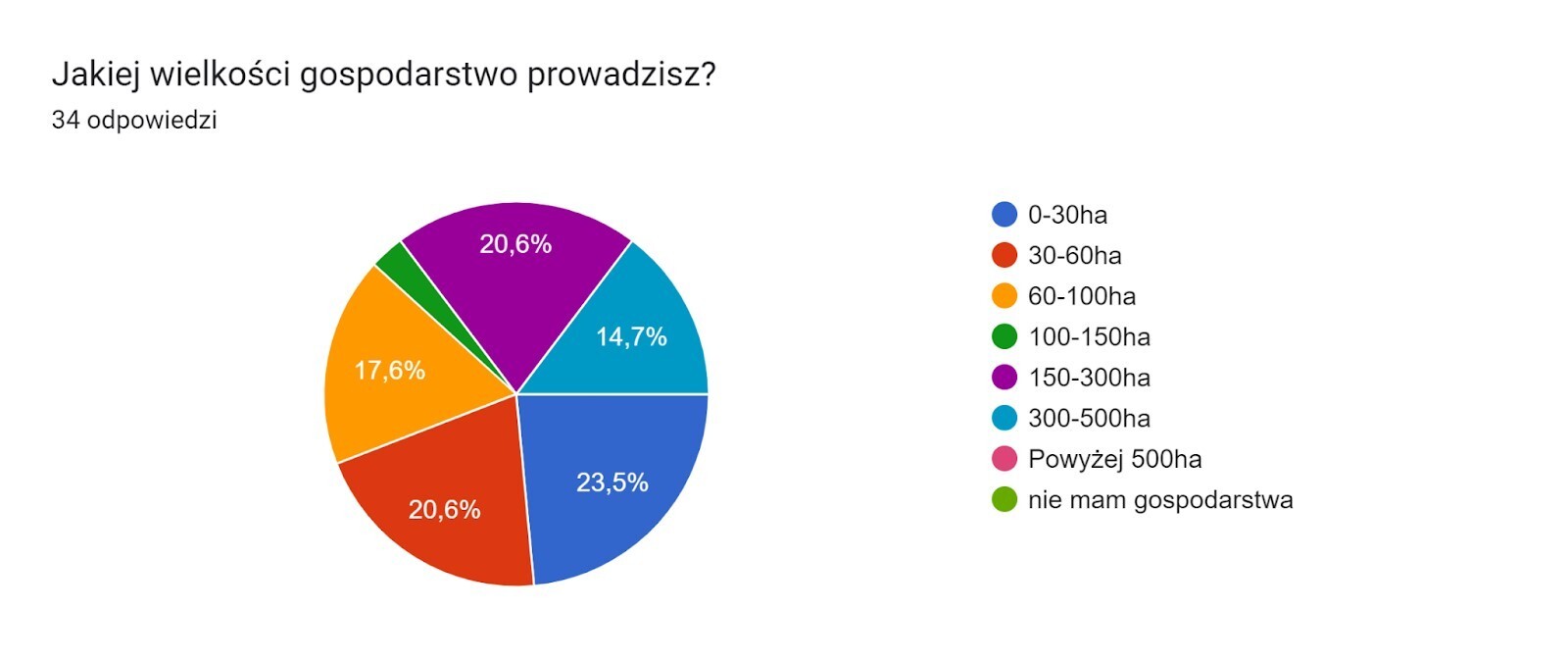
The survey was distributed with questions related to carbon farming among a broad group of farmers, resulting in 34 responses. Despite the relatively small number of respondents, the survey provided interesting insights into farmers' opinions about carbon farming.Among respondents, 50% of farms specialized in crop production, while the remaining 50% combined crop and livestock production. The most common answer to the question about farm size was 0-30 hectares (23,5%), followed by 30-60 hectares and 150-300 hectares (both 20,6%). All respondents declared that the farms were managed either by themselves or by their partners. At the same time, none of the responses came from farms larger than 500 hectares.
 Figure 1. Respondent's farm size.
The survey was distributed electronically, mainly via social media, either directly to respondents or through thematic groups. Among participants, the largest group consisted of individuals aged 18–26 (64.7%), followed by those aged 26–35 (26.5%).
Attitudes toward carbon credit programs
Qualitative and quantitative responses indicate that farmers would like to learn more about carbon farming, with 69.7% stating that more informational materials on the topic should be available. There is a clear need for education in this area, despite the fact that 47.1% of respondents declare that they do not plan to join carbon programs in the foreseeable future.
Figure 2. Need for more additional informational materials.

Among responses to the question, “Explain how you understand the concept of carbon credits,” most answers intuitively referred to carbon sequestration and soil-related concepts. It appears that farmers understand the link between carbon farming, emission reductions, and potential financial benefits from carbon removal. However, none of the responses correctly indicated that a carbon credit represents one tonne of CO₂ equivalent reduced or removed and stored in the soil.
Some responses also reflected concerns about farmers being penalized for emissions or dismissed the concept as “ecological nonsense.” Overall, the survey results suggest curiosity about the topic and generally positive or neutral attitudes. Still, 15.2% of farmers believe carbon farming has no potential and is not worth developing, while 38.2% say they would consider joining carbon programs but lack sufficient knowledge about them.
How much do farmers know about carbon credits?
The survey included several questions in which farmers rated their level of knowledge on a scale from “1 – I know nothing” to “10 – I know a lot.” The results show that farmers feel relatively confident about their knowledge of agronomic methods for soil carbon sequestration and practices that reduce emissions in agricultural operations.
The average score for knowledge of carbon sequestration methods was 5.3 (median 6.5), while for emission-reducing practices the average was 5.9 (median 7). It is interesting to compare these findings with responses to the question, “I know which main production inputs are considered when calculating the carbon footprint,” where the average score was 4.1 (median 4).
Additionally, farmers are not confident about what actions to take on their farms to generate as many carbon credits as possible. These results are presented in the table below.

Table 1. Farmers’ self-assessment of knowledge in selected areas

Responses to the above questions indicate that farmers feel confident in applying carbon practices and are often aware of how to farm sustainably. However, they lack knowledge about how the carbon footprint of the products they use is calculated. This suggests a relatively high awareness of emissions within the farm, but lower awareness of emissions beyond the farm. This can be interpreted analogously to Scope 2 emissions.
Need for education
Respondents’ answers indicate that younger farmers show considerable openness to sustainable solutions, although they often lack sufficient knowledge on the topic. It is also worth noting that 91.2% of respondents are under the age of 35, which may partly explain their openness to more sustainable approaches. Increasing the availability of educational materials could positively influence attitudes toward carbon farming.
Complex regulations and a limited understanding of the business model may discourage farmers from engaging with companies offering carbon programs.
ul. Kętrzyńska 11, 11-420 Srokowo
REGON 529448314
kontakt@agem-agency.eu
NIP 5214082848